
With the Ford Mustang wrapping up the US iteration of this series, it’s time to move across the Atlantic to a country that is perhaps not quite so well known for its automotive culture, but one that is still very well represented by some absolutely amazing automotive icons – France.
As I did with the US, I’m offering five suggestions based on my own limited knowledge. You’re most welcome to add some suggestions of your own in comments and the more they’re supported, the more likely it is I’ll add them to the poll.
——
Anything sporty made by Renault in the last 30 years
Renault’s most noted early foray into sporting cars was with the Alpine company, which started off using rear-mounted Renault engines in competition vehicles in the 1950s. Renault bought Alpine in the early 1970s, abandoned it in the 1990s, only to release a special Alpine concept earlier this year, which I covered here on the website.
The cars I’m concerned with here cross over some of the Alpine timeline, but they’re Renault-badged and intended to descend from their motorsport heritage in formula 1.
It all started with the Renault 5 Turbo, a mad little tin can with a turbocharged 1400 engine, mid-mounted and capable of producing 160hp to propel a body that weighed just under 1000kg. Whilst the standard Renault 5 was front-wheel drive, the Renault 5 Turbo drove the rear wheels and was a regular sight near the front of the European rally circuit in the early 1980s, just before the Group B cars came along and blew everybody away.
Fast forward to the new millenium and Renault now produce their performance vehicles under the RenaultSport badge. They even make a bunch of them in the old Alpine premises, at Dieppe, in France. The RS Clio has traditionally been the purists choice with it’s dedication to pure, normally aspirated acceleration and light weight. The slightly larger RS Megane uses turbo technology to push the front-wheel drive envelope even further and both the Clio and Megane have been lauded by the motoring press in Europe and Australia as the best hot hatches of the modern era.
Here’s the old 5T being driven, along with the RS Megane R26R from a few years ago.
——
Citroen DS
I can hear you now – that’s more like it! The Goddess!
The DS has to be one of the most out-there car designs to ever sell in volume. It’s flowing, graceful lines first appeared in the mid-1950’s and were so good that the car was made for another 20 years with only cosmetic and engine changes through the model run.
And it still looks amazing in 2012.


The ‘Goddess’ was known not only for being super-stylish, but also for its amazing, comfortable ride, which was thanks to an incredible hydropneumatic suspension system. Not only did the car float as if on a cushion of air, it also made for some incredible sights, like the low-slung car you see above.
The DS sold just short of 1.5 million units, an amazing number for car with such unconventional design and engineering.
This 19 minute video will leave you absolutely captivated with the Citroen DS. It includes a brief demonstration of the way you use the hydropnuematic suspension to change a wheel on the car. It’s amazing stuff.
——
Bugatti Veyron
Slightly controversial, this one.
Ettore Bugatti was Italian-born but the Bugatti company was most definitely French. Today, while Bugatti builds the car in France, it’s a little difficult to see it as a French vehicle. The Veyron is 100% conceived, owned and engineered by a German company – Volkswagen.
But….. Bugatti’s heritage *is* in France and that’s where the car is built. It’s one of the most impressive feats in automotive engineering ever, which is why it has to be considered as a modern day automotive icon.
The big question is whether or not people would consider it to be a French automotive icon?
——
Citroen 2CV
Another long-term Citroen that became an unexpected style icon and the vehicle of choice for several million French over its (amazing and basically unchanged) 42 year lifespan.
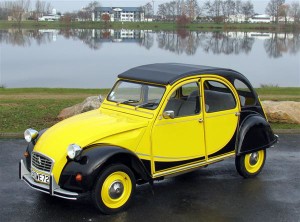 The 2CV started life in a somewhat similar manner to Volkswagen’s Beetle. It was envisioned as a cheap runabout car for the people, many of whom still lived on the land. I love this bit in Wikipedia’s blurb about the design brief:
The new management ordered a fresh and detailed market research survey that was conducted by Jacques Duclos. At that time, France had a very large rural population which could not yet afford automobiles. The results of the survey were used by Citroën to prepare a design brief for a low-priced, rugged “umbrella on four wheels” that would enable four peasants to drive 50 kg (110 lb) of farm goods to market at 50 km/h (31 mph), in clogs and across muddy unpaved roads if necessary. The car would use no more than 3L of gasoline to travel 100 km (78 mpg). Most famously, it would be able to drive across a ploughed field without breaking the eggs it was carrying.
…..and with that brief, the 2CV was born.
It had a lightweight, air-cooled 2 cylinder boxer engine, the first iteration of which produced just 9 horsepower. Later versions would produce a giddy 35hp! The engine is so small, simple and well designed that people still run them in reliability rallies or even world circumnavigations. Yes it’ll get you wherever you want to – as long as you’re not in a hurry.
The car had 4-wheel independent and self-levelling suspension, easily removable panels (multi-colored cars seemed to emerge quite a lot a few decades ago), a 4-speed gearbox when 3-speeds was the standard and a fabric full-length sunroof that allowed large loads to be carried in the back.
And then, there are the looks. The 2CV was a curious enough looking car when it first came along, but such distinctive styling lent itself to plenty of special editions that accentuated the car’s distinct looks, like the Charleston at the top of this section.
One mechanic in England, who happened to be a Picasso fan, decided to blend his passion for the 2CV and art, producing this Picasso-inspired one-off 2CV below:

It had a few starring roles in film, too, the most famous of them perhaps being a chase in the James Bond film, The Spy Who Loved Me. A bit of poetic licence is taken, of course, but I have a feeling the little Duck could have actually survived much of this.
——
Bugatti Type 57SC Atlantic
Unlike the Veyron, there’s nothing questionable about the Frenchness of the Type 57SC Atlantic. It’s an undeniable piece of automotive art and the 2010 sale of one of the three remaining Atlantic’s achieved the highest price ever paid for a car, estimated to have been between $30m and $40million. From its sweeping curves to its riveted ‘spine’, this Bugatti is exotic and as near as cars come to actually, really being unique.
What’s questionable might be its status as an icon.
Car people might have heard of the Type 57SC Atlantic but an icon should represent a particular class of product to everyone, including the regular car-schmo who might recognise a 2CV as being French, but might not have the slightest idea about where the Atlantic came from.
And let’s face it, the average schmo has more chance of owning a Koenigsegg, a McLaren and a Pagani all at once than they have of owning one of these.
French? Yes. Jaw-droppingly beautiful? Absolutely. A French motoring icon to the masses? You can cast your vote on that one in the poll.
The car below is owned by Ralph Lauren. You can’t buy it, but he’ll sell you a one-eighth scale model for ,500.

——
I’ve stopped at 5 entries only, which will be my custom with this series. I’d be more than willing, however, to entertain a nomination for the Alpine 110A if someone’s willing to make a case for it.
And with that, comments are open for your nominations.
—


Hi Swade,
You forgot Renault 4L. A truly groundbreaking little car.
And I really think that it invented lift-off oversteer too!
I saw Renault 4s all over Mallorca when I visited there last year. Looked wonderful. I simply picked the 5 as it ties in better with my own love of RenaultSport (which is firing quite a few imaginations here in Oz, at lease) and because I thought it might have engaged a few more imaginations itself, compared to the 4 over the years.
I could very well be wrong.
The DS, the DS and the DS!!!! The nearest I’ve come to driving one of these is a CX; the DS should be on everyone’s motoring bucket list…but somehow I am just not brave enough. Probably to do with 1, living in country Victoria and 2 being infatuated by my Saab 900’s which are comparatively modern yet classic at the same time. If you looked at the ‘favourites’ on my Flickr account you would find lots of images of the DS – the decapotable versions of Henri Chapron are stunning. I think you have to also consider the SM which has every bit as much grace, with a little bit more pace (thank you Jaguar) – courtesy of its peppy Maserati engine.
The Renault 5 turbo mid engined jobby – probably liked by everyone except Jeremy Clarkson. The Peugeot 205 GTi should not be forgotten for its place in launching the hot hatch alongside the Golf GTI, back in the day.
And yes Swade definately the Alpine Renault’s deserve to be on your list IMHO.
I guess I’m a bit biased towards French cars as my Dad owned:
– A Renault 16 which was very comfortable and had a big boot.
-A 2CV which he dragged against an Audi 80 along a stretch of dual carriageway and out-drove the competitor through the roundabouts
– A CX 2200 Pallas which I crashed just after I passed my test
– and a 205 Gti which I never got to pilot as I had already left home by then.
Thanks for posting these lists, Swade. Good fun and lots of memories. I wonder what cars you will choose from my home country? (England)
Sorry, I should have to request Facel Vega be added to your list Swade…. can’t do without that name sitting on there can we?
Since you mentioned the Vega, here’s a photo of one I took at this years All French Day in Sydney.
http://farm9.staticflickr.com/8168/7571811330_03238be74c_c.jpg
That’s a beauty…c’mon how could it deserve less than iconic status??
Nooooooooooooooooooooooo!
One of the limitations of this poll is that it’s being written from my limited knowledge. I’ll happily acknowledge my own automotive limitations as they are many and they influence/constrain anything I write here. However, with that said……
We’re looking for icons, not curiosities.
When you look at your computer filing system and you see a line of symbols with a little blue “W” on them, you know straight away that it’s a Word document and that piece of software is so well known that you even know it’s a property of Microsoft.
That’s an icon, in both the traditional and modern sense.
I will bet my house that if you took that photo to a gathering of adults, you’d have less than 1% of them know what that car is. In fact, I’ll bet that if you took it to Goodwood during the festival of speed or any of the other shows they hold there, you’d get less than 5% knowing what it is.
The car looks quite nice and it’s probably got some qualities to it that would endear it to some if they had the chance to appreciate it. It might well be the most French car that ever existed. It might run on croissants and say ‘Sacre Bleu!’ when you toot the horn. But it’s not an icon of French motoring, not to my way of defining it, at least.
Having written about icons vs curiosities last night, I should own up to the fact that I may have fallen into the same trap myself with the Bugatti Type 57. I know of the car, love it and think it’s an amazing piece of work, but I may have mistakenly thought others might feel the same. The poll is definitely proving otherwise. Live and learn.
Ian… The UK have to many icons to choose from. And I mean that in a good sense.
*Aston Martin DB5
*Bristol (All… Nah not the 412…)
*McLaren F1 (Tiff Needell… Wooohhoooo)
*Rolls Royce Silver Cloud!
*Bentley Continental fastback coupé
*Ariel Atom
*Caterham and Lotus
*MG
*Triumph
*………
…You see… the list goes on and on. I think Steve need to find those Not so good from the UK 😀
Cheers/Tom
Steve…n (Sorry mate)
You can call me anything you want, mate. 🙂
Bugatti Type 41 Royale… The Ultimate luxury cruise liner. Nothing like it fore or after. And it’s a True Bugatti and not a sporty Das Boring.
I generally avoid cliches like the plague, but Ian took the words right out of my mouth.
1. The DS
2. The DS
3. The DS
4. The DS
5. The DS.
It would surely be in any sensible world top 10 of the greatest cars of all time.
Good list, but I think it needs a Peugeot to be complete. The 504 (the chase car in the Bond clip) is as good a candidate as any. It’s the classic third world “taxi de brousse,” along with the MB W123. It was also sold as an ambulance, commercial van, wagon, pickup (ute), and full-fledged offroader (Dangel conversion).
Hi Bernard,
I really struggled with that but at the end of the day I didn’t want to put a car in just because I thought a brand should be represented. I came close with the 205Gti but just couldn’t put it in the top 5. Maybe it’ll make it on to the extended list for the poll.
I spent a few years riding frequently in a 504 and it was a lot of fun, but just not different or notable enough.
This qualify? 😉
http://www.peugeot.com.au/apr-09-jun-09/peugeot-wins-le-mans/
Very, VERY tempting.
Could it stretch to 10 icons per country??? We’d be alright until it came to Australia (sorry couldn’t resist that 🙂 Clarkson would have us include the Hills rotary washing line to make up the numbers I’m thinking.
The reason is that we haven’t so far mentioned the De Dion-Bouton company who were among the pioneers of steam as well as internal combustion powered vehicles.
http://en.wikipedia.org/wiki/De_Dion-Bouton
We’re working on icons, Ian. Unfortunately, the precludes stuff most people haven’t heard of (I’m most people, in this instance).
There’s a lot of groovy, funky stuff out there. In this series, we’re looking for the most recognisable vehicle that typically represents the country concerned to the average motoring enthusiast. Not anoraks, but just someone with a half decent automotive knowledge (I’m aiming to be half decent, but realise full well that I’m nowhere near there yet).
I’m actually thinking of soliciting a few expert opinions for a couple of the countries coming up on my list. We’ll see how that goes.
From memory there’s a De-Dion on display at The Whitehouse Museum in Westbury though I see your point – it would be in the same vein as the Model-T Ford was in the American section but a case could be made for both cars. I suppose that makes me a borderline anorak then? 😮
I couldn’t list serial numbers or their kid’s names, or even their years of manufacture…
The Citroen SM deserves to be on the list, even at the risk of it becoming too Citroen-biased (is that possible?) – despite having an Italian engine, the SM is much more a French icon than that high-tech German baked potato with the Veyron name. Hard to fault including the R5 turbo or any of the others on your list.
Having recently moved to France and having a bunch of car-mad neighbours who actually drive Bugatti’s as their everyday car, I’d add those.
They were built in this area, they were of a quality of engineering, as well as emotion.
I did show pics of about 10 of them descending on our small village a while back. Next time you’re here, Steve, you know what is gonna be the mode of transport 😉
But, the Peugeot 205, which one still spots in all of its guises, from cow dung lugging small vans, to happily driven GTI’s, did something. A small hatchback which chanhged things in the hot hatch days…..
The french certainly have unique designs. When I was looking at cars as a teenager apart from SAAB I was also fascinated by the Panhard with an 848cc engine.
http://www.studiotimecapsule.com/panhard_24ct_one_of_unique_french_sports_car
I’ve always wanted a 2cv. My brain knows that after the first hour of fun, the actual 2cv experience would be horrible. But my heart loves the odd looking thing.
French cars, like American cars, force one to draw a fine line between “icon” and “cliche”. All of these, save the Veyron (which reeks of Teutonic nouveau riche), are icons. That said…
Anything sporty made by Renault in the last 30 years
Well, as great as any of these may well be, as an American, I’ve not had a chance to buy them, drive them, live with them. I can’t, therefore, vote for any of them. I’d love to own any of them though.
Citroen DS
Catherine Deneuve on wheels. But getting long enough in the tooth to make it less instantly recognizable than it might once have been. I’d peg it as THE icon…if we were having this conversation in 1980.
Bugatti Type 57SC Atlantic
Fast, suave, sophisticated. Also too old and rare to be an icon to anyone that’s not a gearhead.
Which leaves the 2CV
A dented, rusty deux chevaux on a gravel road with bereted driver smoking a Gauloise and a basket with wine and baguettes on the seat is a cliche. It’s also an icon. Even someone with no interest in cars and little knowledge of geography would be able to peg the scene as French.
—–
Side note. When we get to iconic cars of Africa, that’ll be the time to trot out the 504.
I’m glad you mentioned the DS. That is an all-time favorite for me.
A customer used to stop in to say hello in Watertown, and in those days when not in his Saab he was in a dreary-gray/beige 2CV. Having longed for one, I’ve had a model of a 2CV in my office for years. On one visit he let me take it for a jaunt. It confirmed my wanting for one. And in these parts, they’re rarer than unicorns and turn more heads then a Ferrari.
The DS may indeed be “iconic” in that people wanted it instead of settling for it as they have the 2CV back in their respective eras. I wonder, though, which of those cars is more “francaise?”
The 2CV is as French as baguettes and berets. It just doesn’t get much more iconic than that.
Falling under the ‘Renault in the last 30 years’ umbrella, I’ve always had a soft spot for the Renault Alpine A310. The A110 is obviously a great one, too.
I guess the Renault 16TX and the 17 Gordini are older than 30 years, but still deserve a mention.
Citroen Traction Avant – It’s what you think of first when French cars are mentioned….
Renault Espace – All the others are copies.
Citroen DS – Different
Citroen 2CV – The other car you think of
Peugeot 504 – Keeps the Africans mobile
Reserves:
Renault Dauphine
Simca Bagheera
Renault 16
Citroen SM
Renault 4
This is quite easy really. It has got to be the DS.
Why? It is the only ‘truly’ French icon here.
The Bugatti Veyron is German, don’t care that is made in France and that Bugatti is a French company. It is German through and through and if the French had control of Bugatti instead of Volkswagen, it would never have been built.
The Bugatti Atlantic is not well enough known to be considered an icon for the masses.
The 2CV is not a car, it’s a joke.
The Pug 205 while a great little car just does not cut it against the iconic DS!
Everything done in the last 30 years by Renault Sport is too broad a choice. It’s a list of great sporting cars is too hard to break down to just one.
That leaves the DS. Quite simply a stunning car way ahead of anything available at the time and something the French car industry can be very proud of.
Just a slight tangent…
I don’t really like it when car manufacturers have names on their models instead of just numbers. That’s one thing I liked about Saab – the 9-[x] nomenclature of the latter years that really stood out in the crowd. However, I have to admit that French and Italian manufacturers can put name on their cars that makes the little hair I have on my neck stand straight up. Traction Avant, Dauphine, Avantime, Vel Satis, Suprastella, Celtaquatre, Stratos, Gran Sport Quattroruote, 8C Competizione…
Not to mention all the lovely Italian women’s names like Flavia, Giulietta, Flaminia and so on… hmmmm gorgeous; you can almost smell ’em.
The DS.
What a wonderful pice of engineering that is. And to think that it came (with a bang) 1955. Take a look at what other cars looked like in 1955. Very few massproduced cars were so far into the future. And so beautiful.
The 2CV is also an icon. A massive one.
These two are so far ahead of everything else produced in France, that it is almost embarrasing for Renault, Peugeot and… what else is there? Simca? Matra? Talbot?
And I would also like to put Citroën CX on the icon list.
I am saddened by the fact that Citroën-Peugeot have found themselves in such dire straits that they are being “caught” by that controversy called General Motors.